What a Season of Gigs Taught Me:
5 gigs spanning April, May, June 2026 – with images, excerpts and full vids
Recently on Mastodon, c.reider asked the fediverse music community a lovely question, prompted partly by a toot of mine about an upsetting performance: tell us a story of when a performance went wrong. Several responses came in, and reading them made me feel less alone. The gear dies, the monitor vanishes, you press the wrong button at the worst possible moment. The show goes on anyway.
It prompted me to look into my recent gigs, and I realised almost every one went sideways in some small way, and each one taught me something. None of this is a triumph story. Things kept going wrong. I carried on. That turned out to be enough.
Gig 1 – NAUS: a boat on the Thames, and a dead battery (24/04/2026)
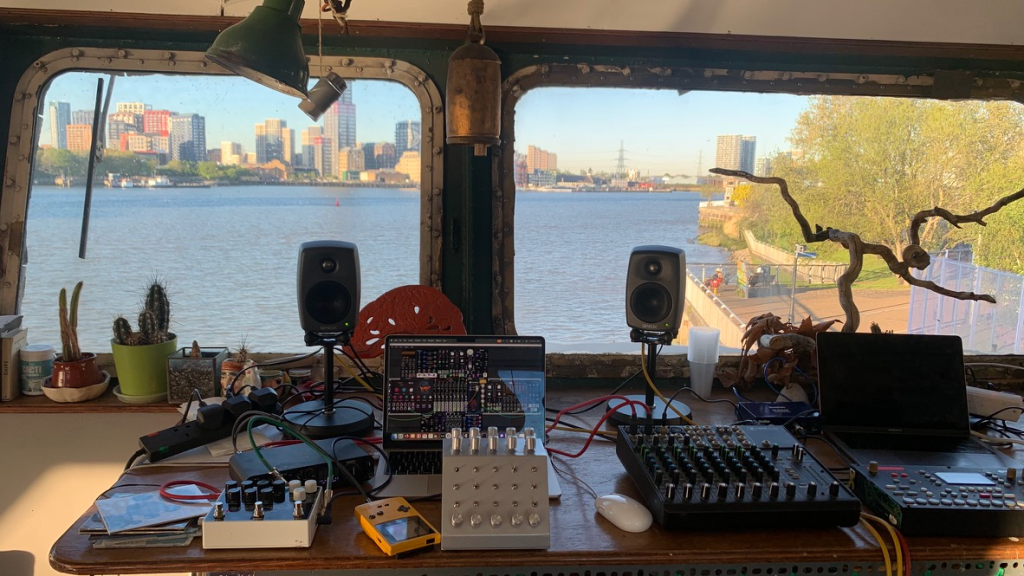
In April I cycled 10 kilometres to a ship moored on the Thames, played a live set in an intimate little room, and cycled home again. The gear was heavy but it fit on the bike, which felt like a small victory in itself. This was NAUS, Stephen Shiell’s series of live electronic nights on A Slice of Reality, a sculptural ship on the Greenwich peninsula. I was there because Stephen saw me play the Freakbox in another gig and asked me along, which is how the best things tend to happen.
My rig was minimal but heavy: a laptop running Live and Cardinal, my handmade Freakbox, a freeze synth pedal, and my Game Boy with LSDJ. I improvised on the Freakbox and pedal first, then switched to the Game Boy. Mid-set, its battery died. I pivoted to SameBoy, the emulator, alongside my Cardinal patch, and it worked, better than worked. SameBoy doesn’t have the original Game Boy crunch, but I’m not one of those people obsessed with hardware versus software. I love both, especially when one becomes the solution. A few people gathered around, seeing my screen, and rather than panic I turned it into some comedy moment before I started my emulator to improv with. A dead battery became a shared moment instead of a disaster, and they kept watching as I added my Cardinal patch in my improv. That’s how I like to play: live, organic, a little vulnerable, everything happening in the room, prepared but with no safety net of pre-baked tunes. I’ve done this long enough to properly enjoy it now, though part of me is never quite calm.
The lesson: a minimal setup and your laptop music you know well is what lets you stay calm when something fails. The NAUS rig worked because it was small and familiar, more “thank goodness I travel light” than “disaster”, and light enough to cycle in on a day of transport strikes, which suits me, since I don’t much enjoy buses or cars anyway.
The good thing: It was an amazing event with Tom Hirst and Mohammed Rowe also on the bill. Extraordinary space to perform, in that ship. Very thankful to Stephen Shiell. And the scrappy, battery-dead, emulator-pivot version is the one now being broadcast on Resonance Extra, which feels like the whole point somehow.

Link to the set on Resonance Extra: https://extra.resonance.fm/episodes/naus-2026-07-02 – my set from 38:30
Gig 2 – Diaries of Destruction at Reinstate: one monitor, and choosing which gigs to take on (16/05/2026)
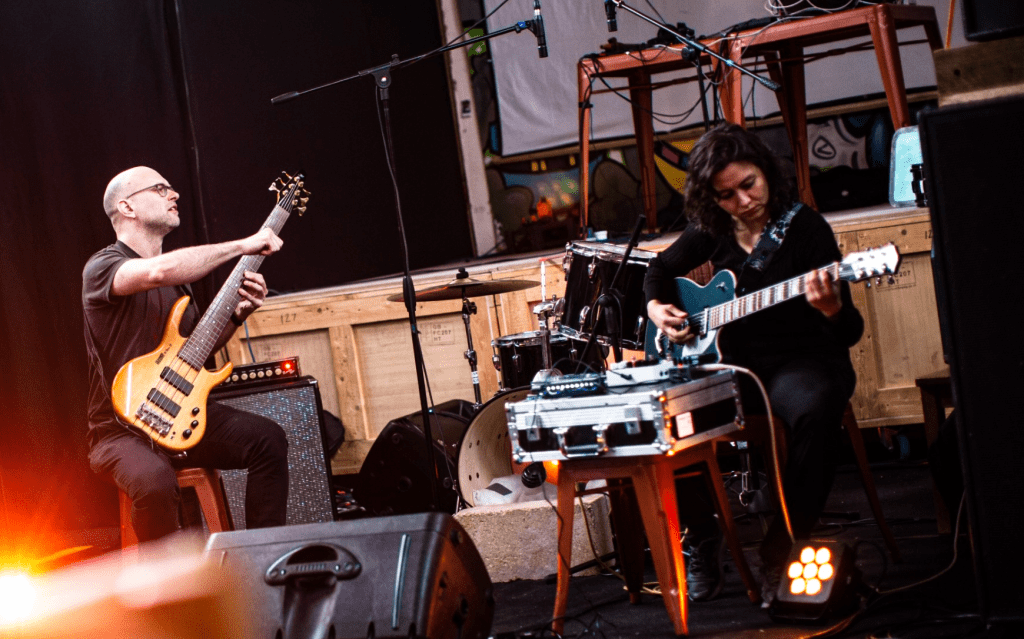
In May I played on a DIY day at a social space called Reinstate Project in Silvertown, as Diaries of Destruction, my experimental metal project, with my partner Jordan Muscatello on bass, myself on the baritone guitar. The event had everything going on: seminars, DJ sets, stalls for creatives, a genuinely good initiative and an open, inclusive space. But the tech I’d asked for wasn’t there, the monitors were set for a later band, and the suggestion was that we borrow another band’s amp to hear ourselves through, which I declined. We ended up with two fuzzy sources going into a single monitor between us. Too loud, feedback all set. I wasn’t happy with how I got to present the music.
The lesson: be careful about saying yes for purely friendly reasons. I love these DIY nights and I wanted to support this one, but if the technical conditions you need won’t be there, it’s fair to say no. You can believe in a scene completely and still protect your own work. None of this is a knock on the organisers, who put so much effort. It’s more about myself.I’ve concluded I’d rather commit to events where I trust how they’ll run.
The good thing: people loved it, and playing something heavy and uncompromising with Jordan, who felt exactly as I did about the sound, was a joy.
Check the excerpt: https://youtu.be/zf1ZQMLTYV4
Gig 3 – Gravitons: my “first proper” livestream (20/05/2026)
In May I did a livestream for the Fediverse Gravitons series, a community space for experimental electronic music. It was one of the gigs I looked forward to most, because it was my first chance to properly connect with the people I’ve met and reconnected with on Mastodon, away from toxic spaces like Instagram and closer to the people I actually want to be in touch with, including fellow artists. It was my first time using OBS and only my second time streaming at all. I have a YouTube channel I barely update; I’ve never much enjoyed self-promotion or the visual side of things, so I didn’t even own a proper camera, only a webcam. And I set myself a big task: four sections across four setups, Cardinal, the SameBoy emulator, Live and Max for Live for hardcore and some microsound stuff, and my guitar with the freeze pedal, plus the Freakbox, my Mastodon mascot, which was never going to miss it. I wanted to show my current obsessions, the dynamics and sonic extremes I keep chasing. It all worked, in its own way. But juggling with the soundcard, the camera and the virtual audio routing on top of the music meant I played the whole thing a bit stressed, and the prep was worse, since I’m no OBS nerd and still have little interest in learning to video and stream. With so many sound sources, the balances I’d set were hard to keep track of once I was live.
The lesson: don’t be so hard on yourself when you’re carrying a lot at once. Narrowing the focus would have helped. I was most relaxed in the Cardinal section, because it’s just one thing without fiddling with camera settings etc. I could happily have played only that and saved the rest for another stream. Or only Live and Max, or only the Freakbox, or Renoise, or the Game Boy. Whatever you make has value, errors and all, whatever anyone else decides to say about it. We don’t need to prove anything to anyone, all these things are good enough. Having more stuff won’t make you more interesting.
The good thing: it did the thing I actually wanted, which was to meet and talk properly with the people I know from Mastodon, fellow artists included, more directly than a feed allows. And it was their chance to be introduced to me properly. Even the quieter-than-planned OBS audio, which got fixed afterwards, didn’t take that away. I am very thankful to thisoccasionalsociety and Meljoann for inviting me to do this.
SS from OBS livestream below, enjoy the full Cardinal part: https://youtu.be/IGwe_ixXr1A

Gig 4 – “Gameboy John” at Skullstice: the track I erased (14/06/2026)
I got a last-minute call to step in for a short gabber-like set with my Game Boy at Skullstice, at Spanners in London, just me and a Game Boy, for fun. “Gameboy John” is a character I invented out of a joke, my funnier, crazier side, noisier and more experimental than the uplifting chiptune associated with Game Boy, which is a side of chiptune I’ve never much connected with, so I explore other things. This was her first proper outing. Because it was last minute I built the LSDJ track on the day, saving as I went. Then, five minutes before the set, I found out I’d hit erase instead of save and wiped the whole thing! I couldn’t regulate in the moment, got very upset, and stepped away. Then I came back and played a short, improvised speedcore-ish set of bleeps and bloops from older sketches I hadn’t touched in a while, with live improv enjoying the R command to pull varied results out of LSDJ’s white noise channel and the P command for aggressive, hard kick synthesis on the pulse channels. I also brought a second Game Boy running a Kirby cartridge, so I kept the set short and, at the end, started Kirby up and left it playing as a joke. Could have been better. Was still something. I stayed upset about the lost track for a good while after.
The lesson: back everything up properly and do it in a healthy way. I have solid systems for all my other gear; the physical LSDJ is the one that always lived dangerously, probably because I barely used it as a standalone performance instrument before. And another lesson: think twice about last-minute commitments when you’re not sure the materials are ready, even the fun ones. Try not to obsess anxiously over a file either, since all that frantic saving is exactly how you end up hitting erase, almost a self-fulfilling prophecy. Being upset is allowed. Stepping away and coming back is a skill.
The good thing: people loved what I improvised, Kirby stuff as well, and Gameboy John got a first life even if her best song didn’t survive it. She’ll be back, once I’ve rebuilt the track. And oh, another gig that included cycling, which is good.
See this Gameboy John excerpt: https://youtu.be/BD8xbwQmX6c

Gig 5 – Heart of Noise St Giles: the modular’s first outing (28/06/2026)
On 28 June I co-organised and played Heart of Noise 15 at St Giles Cripplegate, a beautiful church by the Barbican, and it was the first time my modular had ever left the house to perform. A solo set, then a duo with Philamelian, who played beautifully. A week before the gig the modular case had blown a fuse and I had replaced it: I even brought spares along, though I didn’t expect it to go again so fast, having reluctantly pulled a module after checking my power draw in ModularGrid. But yes, there you go, the fuse died again shortly after soundcheck, right before and we replaced it.
If this season has a theme, it’s the blown fuse: gear breaks, you fix it, you carry on. I was stressed, being one of the organisers as well as playing 2 sets. Heart of Noise is my own series, with more to write about that another time, and this was its London debut, after having to suspend it for lack of funding.
The modular deserves a word, cos’ it took me until my late thirties to have one of my own. No shortcuts, no rack handed down to me, just years of wanting it and slowly getting there, then only about a week to fill it once I had it, because I knew exactly which modules I wanted. I’m grateful to Os at Expert Sleepers for the case. Playing it for the first time in that church, fuses and all, meant all the more because the road to it had been so long. And I don’t play my modular “correctly”: no diatonic scales, no tidy chord sequences, no obedient tuning. I find that kind of playing boring, which I don’t mean as a snub, it’s just not where the interest is for me. It’s closer to Buchla-style experimentation, which is one of the core ideas of modular anyway. I enjoy finding sounds by ear, keeping the surprising ones, letting the settings throw up weird exciting beautiful results, even ones that might sound wrong to someone else. That isn’t a flaw in the method. It is the method for me.
What the night also clarified for me is what I actually care about in a room. A beautiful church gives you its acoustics for free, which was the reason I wanted to present my duo project with Philamelian: acoustic piano (him), and electronics (me processing his sounds) here. And what matters to me is appreciating and making the most of those church acoustics, and making sure the artists can hear each other and are spoken to, far more than any amount of impressive gear.
The lesson: keep the technical side in hands you’ve chosen and trust, without last minute arrangements, and with good communication and understanding about the style and space. I’ve learned that leaving those parts to chance, however well meant, tends to come back to me. Good intentions and good equipment are not the same as someone who listens to the room.
The good thing: two debuts in one night. My modular’s first time out of the house, and Heart of Noise’s first London edition, presented by TimbreWorks, in a church I’d wanted to fill with this music for a long time. Fuses and all, it happened, and filling that huge stone room with sound, next to Philamelian, was worth every bit of the stress.
Watch the modular set in St. Giles here: https://www.youtube.com/watch?v=Z51NTXV2Kw8

On sound, and knowing what you need
One thing this season taught me is that how your music is heard is part of the work, not an afterthought. I’ve played in beautiful spaces where more gear and more spectacle only got in the way, and rougher DIY nights with a single monitor to share for a fuzzy doom metal duo. I’ve been handed monitoring I didn’t know how to use, which is no monitoring at all when you’re about to walk on, as I’m not Trinity in Matrix to load it in my brain immediately to start flying some helicopter.
What I’ve concluded is this: if you can afford to do it, design your own sound, with engineers you trust who understand the music, ideally people you’ve worked with before. Restraint often serves a piece better than power. A church wants its acoustics; experimental electronics there doesn’t need a stadium rig. When it isn’t your call, clear communication matters enormously, and being able to say “actually, let’s not” before things get complicated. Even the small mechanical habits count, like muting before you unplug, so a room doesn’t jump with a sudden mistake.
What it all comes down to
It all comes down to learning to represent your own music, on your own terms, with care for the conditions it arrives in, and don’t take on so much that you stop being kind to yourself along the way. I’ve been overcommitted with lots of stuff, and the reason I do gigs on top is because I love them but it is sometimes time to pause. The right setup, the right people, the right room, and knowing which invitations to accept. Not fussiness. Care.
I’m still learning, and I can’t wait to take the modular out again, or to play my guitar in a different way. There’s one thing I haven’t concluded, though, and maybe you can help. Every one of these gigs used a different instrument: baritone guitar, Cardinal, Game Boy, the modular, Live & Max stuff. Each kept deliberately minimal, each with its own logic and limits. I don’t know yet whether that makes me versatile or just a jack of all trades. c.reider’s question got me telling these stories; I’ll put this one back to the same community. If you play many instruments, or work many different ways, does it make you stronger, or more scattered? I’d like to know.


Leave a comment